Castillo de Santa Catalina: The Castle That Isn't
From the beach, it has all the hallmarks of a proper medieval fortification: a tower, crenellated walls, arched windows. But the Castillo de Santa Catalina, which watches over the point where the Atlantic meets the Mediterranean, was not built in the Middle Ages. It was built in 1930.
This is not a disappointment. It is, if anything, a more interesting story.
The Hill Came First
The Cerro de Santa Catalina, the rocky promontory on which the castle sits, has been strategically important for centuries. The same hill served as a lazaretto during the plague epidemics of the seventeenth century, was converted into a gunpowder store in 1771, and was fortified as an artillery position by English forces during the Peninsular War, complete with a dry moat cut into the rock. The Spanish coast here has always needed watching.
The building you see today, however, was commissioned by the Spanish Ministry of the Navy and completed in 1933, designed by the architect Julio Murúa in a deliberately historicist style (part Italian Renaissance, part neogothic) intended to sit comfortably alongside Tarifa's genuine medieval landmarks. It was built to look like a castle. It is actually a maritime semaphore station, constructed to control and monitor shipping traffic through the Strait of Gibraltar.
A Signal Station in Disguise
For most of the twentieth century the castle served a thoroughly practical purpose: coordinating vessels moving between the Atlantic and the Mediterranean through one of the world's busiest shipping lanes. From the tower, the entire width of the Strait is visible, Morocco to the south, Gibraltar to the east, and signals could be exchanged with the lighthouse on the Isla de los Palomas at the tip of the peninsula below.
It was used as a shipping traffic control centre until around 2000, when operations moved to a modern facility. Ownership passed to the Tarifa town council in 2001. Since then it has been largely unused, the subject of unrealised restoration plans. It is now a Bien de Interés Cultural, the highest level of heritage protection in Spain.
Viewing It
The castle is not open to the public and the site is fenced. You cannot go inside. What you can do is walk to the headland and take in the views from the surrounding area: Playa Chica curling away to one side, the causeway to the Isla de los Palomas on the other, and the Strait spread out to the south with Africa on the horizon.
It is also worth pausing at the Big Fish on the way, the large iron tuna sculpture near the beach that commemorates Tarifa's Almadraba fishing tradition, one of the oldest in the world. The two landmarks sit close together, and together they tell you something about what this place has always been: a narrow neck of land between two seas, used and watched and fished and signalled across for thousands of years.
From the apartment, the walk takes around fifteen minutes.
Come and see for yourself.
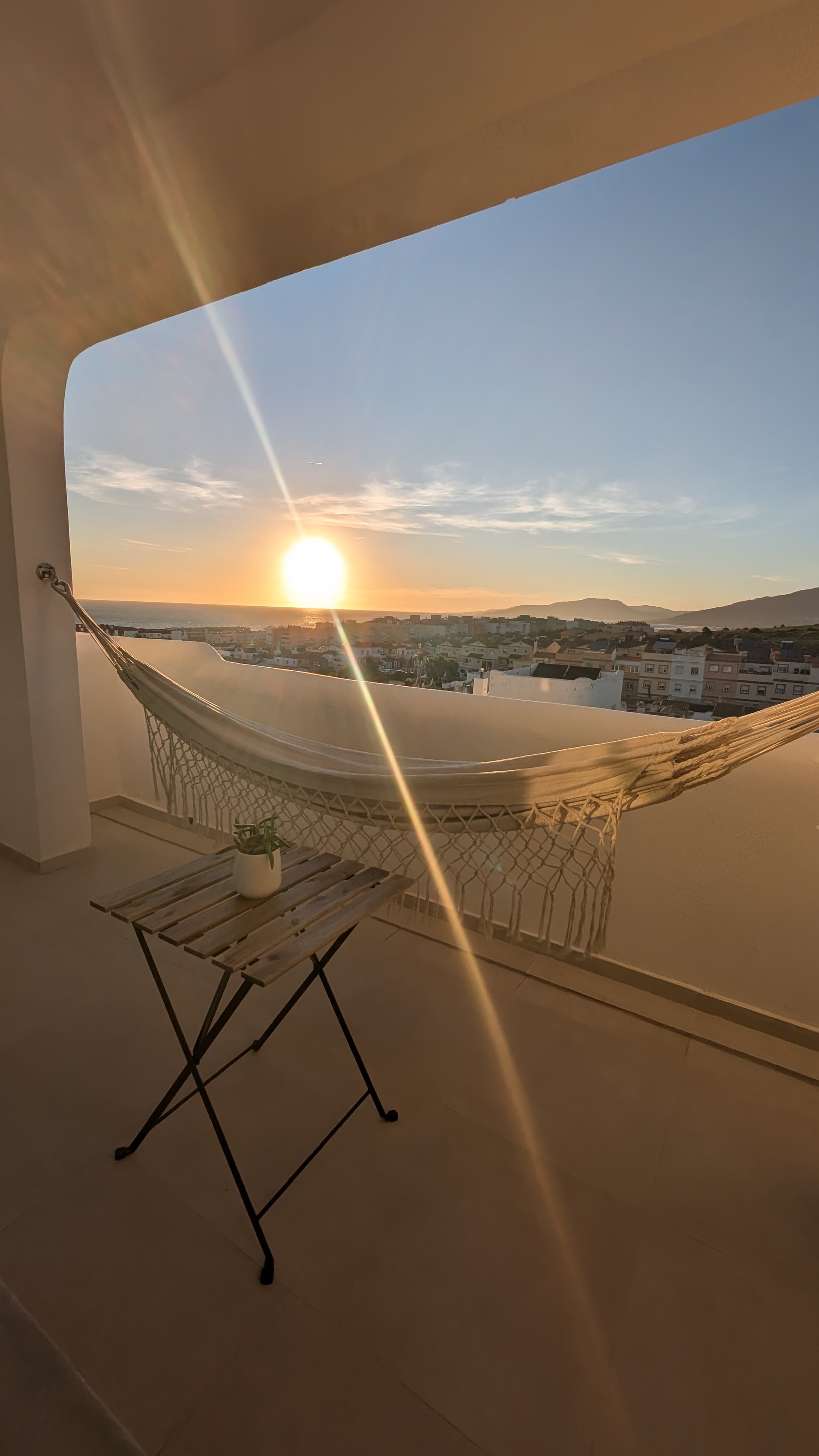
The terrace faces south. Africa on the horizon.