Is Tarifa in The Alchemist? Paulo Coelho's Real Setting Explained
Paulo Coelho's The Alchemist has sold over 65 million copies and been translated into more than 80 languages, making it one of the best-selling novels in history. Most readers know it as a fable about following your Personal Legend: a journey from the familiar into the unknown, guided by the soul of the world. What fewer readers realise is that the story begins in a specific, real place: a small town at the southernmost tip of Spain, where Europe ends and the Strait of Gibraltar opens toward Africa.
That town is Tarifa.
Santiago's Tarifa
The novel opens with a young Andalusian shepherd named Santiago, who has been travelling the same roads with his flock for two years, sleeping in abandoned churches and open fields. He arrives in Tarifa, described simply as "a small city near the port", and heads for a ruined church where he has spent the night before. There, he dreams of treasure buried near the Egyptian pyramids.
The following day, Santiago wanders through Tarifa's market, eventually meeting a mysterious old king named Melchizedek, who speaks to him of Personal Legends and the Soul of the World. It is in Tarifa that Santiago makes the decision that sets the entire story in motion: he sells his flock, crosses the Strait to Morocco, and begins the journey that will take him across the Sahara to Egypt.
Coelho does not describe Tarifa at length, but he does not need to. The town is felt rather than seen. It is a threshold. A place where one world ends and another begins.
Why Tarifa?
Coelho understood something about Tarifa that takes most visitors a little time to feel but almost all of them eventually do. This is a place of extraordinary convergences. Two oceans, the Atlantic and the Mediterranean, meet here in the narrow waters of the Strait. Two continents face each other across fourteen kilometres of open water: Europe behind you, Africa ahead. Two winds, the Levante from the east, the Poniente from the west, divide the air. The light changes differently here than anywhere else in Spain.
People who come to Tarifa often find it difficult to describe the effect the place has on them. There is something in the quality of the air, the visibility of the horizon in all directions, the awareness of being at an edge, that tends to sharpen thought and loosen habits. Writers, artists, and seekers of various kinds have been drawn here for decades. The spiritual and wellness community that has grown in Tarifa (yoga teachers, breathwork practitioners, meditation retreat leaders from across Europe) did not arrive by accident.
Coelho, in placing his shepherd here at the moment of his great decision, was precise. Tarifa is exactly the kind of place where a person might reconsider their life.
The Real Places
The ruined church where Santiago sleeps is thought to be based on the Castillo de Santa Catalina, the medieval fortress that sits at the very tip of the promontory, where the Atlantic and Mediterranean visibly meet. Whether or not this is the specific inspiration, the castle has the same quality as Coelho's abandoned church: a place outside ordinary time, overlooking something vast.
The market where Santiago meets Melchizedek could be any of the narrow streets of the old town, which still feels largely unchanged from the description in the novel. The market square at the centre of the casco antiguo, the Moorish walls, the sense of a place that exists slightly apart from the mainstream of modern Spain, all of it corresponds.
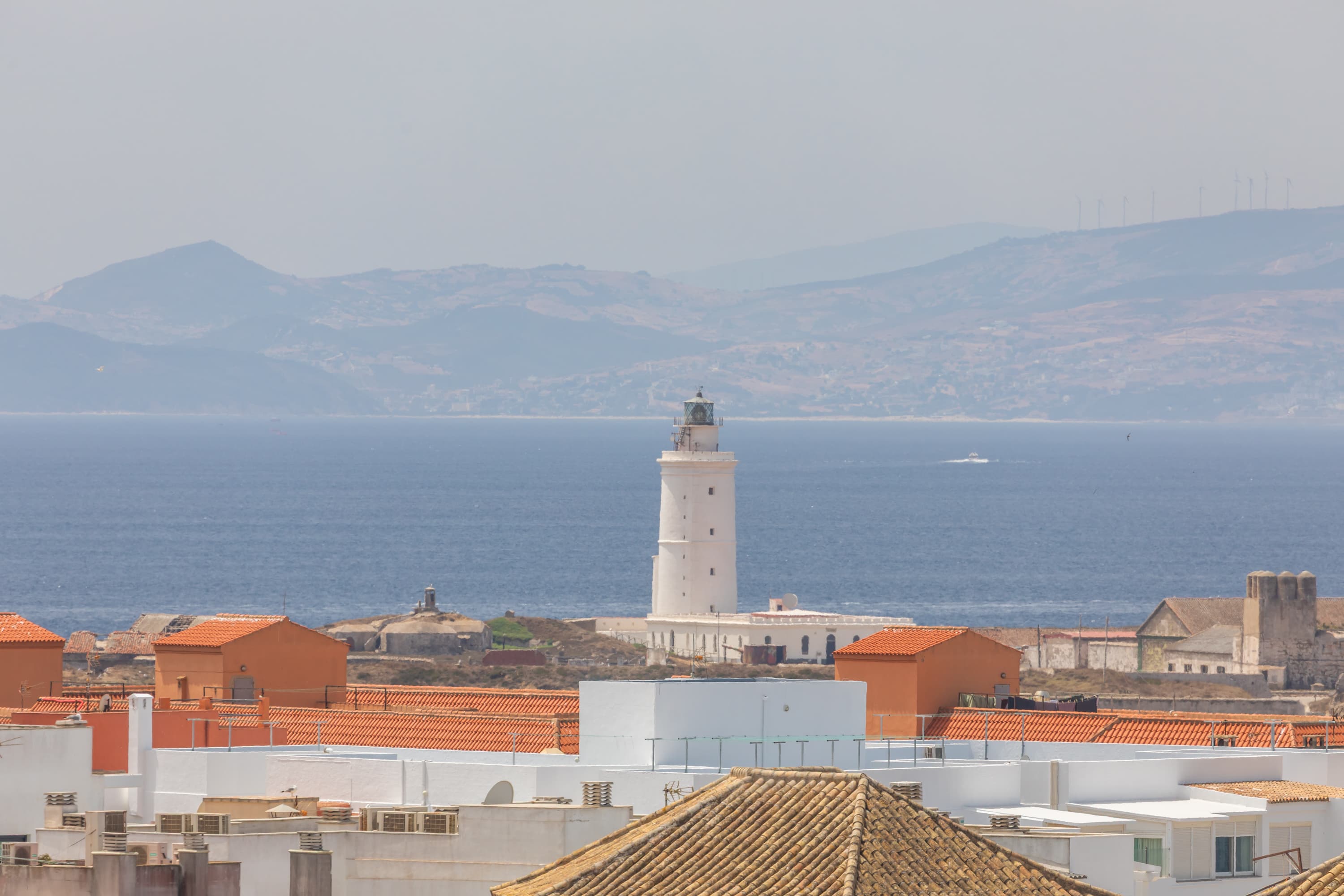
And the view south, across the Strait to Africa, which Santiago sees before buying his ticket on the ferry, is unchanged. On a clear morning, Morocco is as visible from Tarifa's old town as it was when Coelho wrote the scene. The mountains of the Rif rise from the sea. The windmills on the Moroccan coast turn slowly. The crossing that seemed so momentous to Santiago takes thirty-five minutes by fast ferry.
Coming as a Reader
Many visitors come to Tarifa specifically because of the novel. They come to stand where Santiago stood, to look at what he looked at, to feel the thing that Coelho was pointing at when he chose this town as the starting point for a story about following your soul.
What most of them find is that the book was right. There is something here. The energy of the place, the wind, the convergence of elements, the visibility of Africa, the long tradition of pilgrimage and passage through this narrow channel, produces in many visitors exactly the sensation the novel describes: the feeling of being at a threshold, with a choice about which direction to move.
Whether you read The Alchemist as a spiritual text, a fable, or simply a good story, Tarifa gives it a physical reality that changes the way the book sits in memory. Santiago's decision to sell his flock and cross to Africa no longer feels like fiction. It feels inevitable: the only natural response to standing where he stood, looking at what he could see.
Terraza Atlántica sits just a few minutes' walk from the Old Town and beaches, with a terrace facing south across the Strait, the same view that sent Santiago across the water. Africa is fourteen kilometres away on a clear day. Check availability if you'd like to see it for yourself.
Frequently Asked Questions
Is The Alchemist set in Tarifa?
Yes. Paulo Coelho sets the opening of The Alchemist in Tarifa, a small town at the southern tip of Spain. It is where the shepherd Santiago arrives with his flock, has his recurring dream, and makes the decision to cross the Strait of Gibraltar to Africa.
Did Paulo Coelho visit Tarifa?
Coelho has described Tarifa as a place of powerful energy and convergence: two seas, two continents, two winds. His description of the town in the novel is precise enough that it is clearly drawn from direct experience of the place.
Where is the ruined church in The Alchemist?
The ruined church where Santiago sleeps and has his dream is widely thought to be inspired by the Castillo de Santa Catalina, the medieval fortress at the very tip of Tarifa's promontory, where the Atlantic and Mediterranean visibly meet.
Can you visit the places from The Alchemist in Tarifa?
Yes. The old town, the castle, the market streets, and the view south across the Strait to Africa are all real and largely unchanged. The ferry crossing that Santiago takes to Morocco still runs from Tarifa's port, taking around 35 minutes.
Come and see for yourself.
The terrace faces south. Africa on the horizon.